Roof Leaks Around Solar Panels: Causes & Repairs
Got a leak near your solar panels? Learn common causes, what to look for, and how pros coordinate with solar companies to diagnose and repair it right.
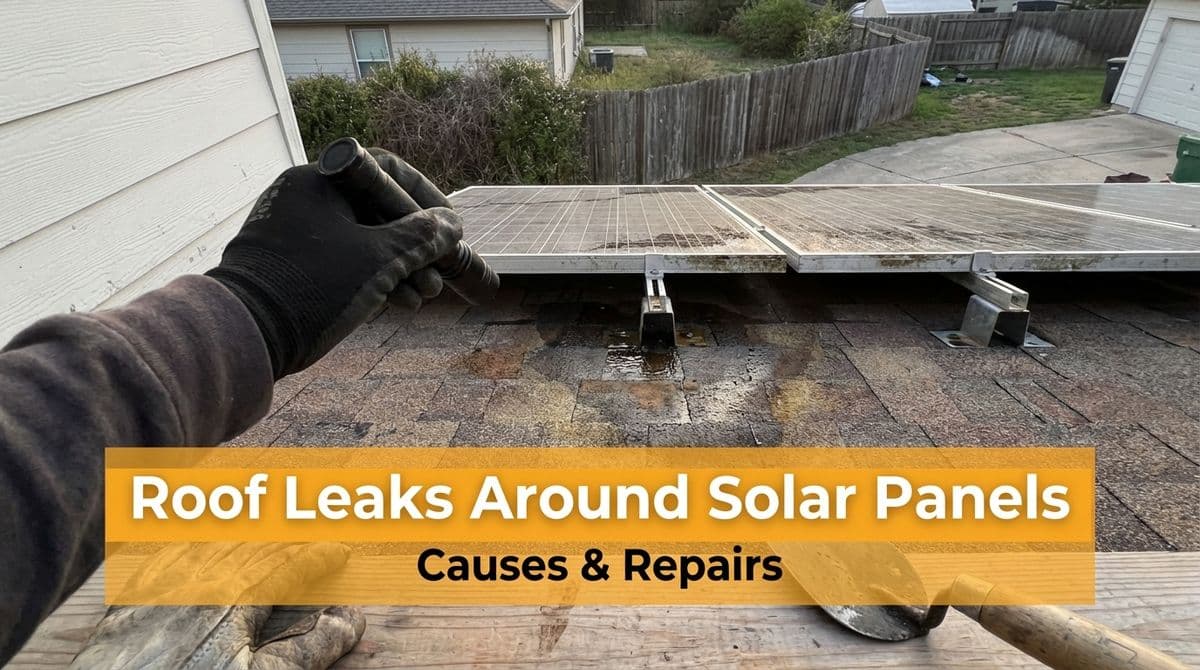
When a “Mysterious” Roof Leak Lines Up With Solar Panels
We recently got a call from a homeowner — let’s call him Mark — who told us, “I’ve got a roof leak, and it seems to be right under my solar panels.” He’d already climbed up, shined a flashlight around, and couldn’t see anything obvious. But inside the house, the ceiling stain lined up almost perfectly with where one of the solar stanchions (the mounts that penetrate the roof) sat.
That’s a story we hear a lot: the roof looks fine from the ground, the panels look fine from the street, but water is showing up inside. In Mark’s case, just like in the call transcript above, we scheduled a quick inspection and estimate first — then coordinated with our solar partners to get everything opened up safely.
If you’ve got solar on your roof and you’re worried about leaks, here’s what we walk homeowners through on every visit.
Why Roofs Leak Around Solar Panels
Anytime someone drills through roofing to anchor solar panels, they create a potential leak point. Done right, those penetrations are properly flashed and sealed; done wrong, they can become a slow, hidden water pathway.
Here are the most common causes we see when a leak lines up with solar equipment:
- Improper or missing flashing – The metal flashing that should divert water around each mount isn’t installed correctly, or not at all.
- Failed sealant around stanchions – Caulks and sealants dry out, crack, or separate from the shingle over time, especially in sun and heavy rain.
- Fasteners driven in the wrong place – Screws or lag bolts sunk into thin sheathing or gaps instead of solid rafters can loosen and leak.
- Roof age and wear – Solar may be “new,” but if the shingles are already at the end of their life, they don’t hold up well to penetrations.
- Improper wire or conduit runs – Cables sometimes pass through the roof without proper boots or flashing, leaving a raw opening.
From the ground, everything can look normal. Even from the roof, you may not spot a problem unless you know exactly how the mounts and flashing should be layered.
What Homeowners Can Look For Before Calling a Pro
We never recommend pulling panels off yourself, but there are a few things you can safely check that help narrow down the issue:
- Inside the house
- Look for new or growing brown/yellow stains on the ceiling or upper walls.
- Check in the attic (if accessible) during or right after rain for damp insulation, darkened wood, or active drips.
- Note exactly where you see the leak — measure from nearby walls — so we can line it up on the roof.
- Outside on the ground
- Stand back and see if any shingles around the array look curled, missing, or mismatched.
- Look for rust streaks, exposed metal, or sealant blobs at the lower edge of the panels.
- Check gutters and downspouts for overflow that might be pushing water back under the roof edge.
If the stains or drips only appeared after solar was installed, that’s important information. We always ask homeowners what changed recently — new solar, reroof, or even satellite removal can all be clues.
How We Diagnose a Leak Around Solar Panels
When we arrived at Mark’s home, step one was a full roof and attic inspection. We didn’t jump straight into removing panels; we started by confirming the leak path.
Here’s our typical process for these calls:
- Attic check – We trace water stains back “uphill” to see where they enter the roof deck, not just where they show up in the drywall.
- Roof surface inspection – We carefully walk the roof, looking at the area around each mount, conduit penetration, and junction box.
- Aligning interior and exterior – We line up interior measurements with the layout of the solar rails and stanchions on the roof.
- Targeted water test (when needed) – In dry weather, we may run controlled hose tests to see exactly when and where water appears inside.
Once we’re confident the leak is related to solar hardware, that’s when coordination with a solar company comes in.
Who Handles What: Roofer vs. Solar Company
One of Mark’s big questions was, “Do I call you or my solar company?” The answer is usually: both, but in a coordinated way.
In our case, we handle:
- Diagnosing whether the roof itself, the solar penetrations, or both are at fault
- Removing and replacing shingles, underlayment, and flashing
- Repairing water-damaged roof decking, fascia, or sheathing
The solar company typically handles:
- Disconnecting power and safely removing panels and racking
- Reinstalling or adjusting mounts and hardware to current specs
- Confirming electrical safety and restoring system operation
We coordinate all of this so you’re not stuck playing middleman between trades or worrying about whose warranty covers what.
How Pros Actually Repair Leaks Around Solar
Once everything is safely powered down and the panels are lifted, the real roof work begins. A typical repair looks like this:
- Expose the problem area – We remove shingles and underlayment around the suspect mounts to see the condition of the decking and fasteners.
- Replace damaged wood – Any rotted or delaminated sheathing gets cut out and replaced with new, properly fastened decking.
- Correct or upgrade mounts and flashing – We make sure each stanchion is anchored into solid structure and properly flashed under the shingles, not just smeared with caulk.
- Install new underlayment and shingles – We weave in new waterproofing and shingles, tying everything into the existing roof system.
- Reinstall solar hardware – The solar crew reinstalls rails and panels, and we double-check all the roof penetrations one more time.
Done right, the repaired area should be at least as watertight as the surrounding roof — and often better, because it’s essentially “upgraded” to current best practices.
Preventing Leaks Before You Install Solar
If you’re planning solar but haven’t installed it yet, you’re in the best position of all to prevent headaches later. Here’s what we advise homeowners:
- Have your roof inspected first – If your shingles are more than 12–15 years old, consider reroofing before solar goes on. It’s cheaper than tearing off and reinstalling panels a few years later.
- Use roofers and solar installers who coordinate – Ask if your solar company partners with a licensed roofer and who’s responsible if a leak develops.
- Get warranties in writing – Clarify roof warranties, solar warranties, and how roof penetrations are covered by each.
- Avoid unnecessary penetrations – Plan equipment locations (inverters, junction boxes, conduit) to minimize roof holes where possible.
A little planning up front can add years of trouble-free life to both your roof and your solar system.
Common Questions We Hear From Homeowners
“Is my roof warranty void because of solar?”
It depends on your roofing manufacturer and how the solar was installed. Some warranties exclude penetrations by third parties; others allow them when done to spec. That’s why documentation matters. When we’re involved before or during installation, we follow manufacturer requirements so you keep as much protection as possible.
“Who pays if there’s a leak?”
Responsibility is usually tied to who did what. If the roof was sound and the leak clearly traces to an improperly flashed mount, that often falls under the solar installer’s workmanship warranty. If the roof was already failing or beyond its expected life, the homeowner may need a roof repair or replacement. We help document our findings so you have something concrete to take back to the solar company or insurer if needed.
Noticed a Leak Near Your Solar Panels?
If your situation sounds anything like Mark’s — ceiling stains lining up with your solar array, especially after heavy rain — don’t ignore it. Small drips can quickly turn into rotten decking, mold, or damaged electrical components.
Give us a call, and we’ll start the same way we did with him: a focused inspection, a clear explanation of what we find, and a plan that keeps both your roof and your solar investment protected.